
Work → Uprise RI
The newsroom that reads every word of the public record.
Uprise RI covers Rhode Island with a small human editorial team and a roster of AI reporters — publishing sourced local news across all 39 cities and towns, tracking every bill at the State House, and turning hours of council-meeting video into stories people actually read.

More public record than any newsroom can read.
Rhode Island produces a staggering amount of public information: 39 cities and towns, a State House that moves 3,000+ bills every session, and councils, school committees, and agencies posting meeting videos and reports every single week. Meanwhile, the number of working local journalists keeps shrinking. Most of that record is never read by anyone.
The brief: build a newsroom where software does the reading — every bill, every meeting, every notice — and people keep the judgment. Not a headline-rewriting bot farm; a real editorial operation with standards, sources, and accountability, run by a staff of one.

From public record to published story.
Every article travels the same road. No step gets skipped, and the risky ones end at a human.
Eleven kinds of watchers
News feeds, town YouTube and Vimeo channels, state agency data, legislation, layoff notices — 11 different source engines check Rhode Island's public record around the clock.
Stories propose themselves
The system drafts story pitches with early sourcing attached. Thin ideas die here — and every editor rejection teaches the next batch what's not worth pitching.
A dossier before a word
Approved pitches get a research dossier: primary documents first — bills, filings, agency data — with every source typed, linked, and graded before writing begins.
An AI reporter writes
Each reporter has a beat and a voice, and writes to a strict style guide: facts only from the dossier, first-hand sources over headlines, shorter over padded.
Gates, not vibes
Automatic checks measure sourcing, verify bill status against the official record, and inspect every generated image. Anything short of the bar stops moving.
Publish — or hold for a human
Clean stories go live and out to newsletters and social automatically. Anything flagged waits on the editor's desk with the reason spelled out.
The boring parts run themselves — the judgment doesn't.
One platform, four newsrooms' worth of output.
The meetings nobody else has time to watch
Town councils and school committees post hours of video every week. The platform finds those recordings, pulls the transcript, cleans it up, and verifies the spelling of every name with a web search before a story is drafted.
Routine meetings become tidy roundups on their own. Anything that looks like real news becomes a standout story pitch — held for a human to approve.
A two-hour meeting, read in full.
BillBuddy: 3,000+ bills, zero legalese
Every Rhode Island bill gets a plain-language summary and impact ratings — how many people it touches, how big a change it makes. Enter your address and see your own legislators, their sponsored bills, and their voting records.
Follow a bill, a topic, or a legislator, and BillBuddy emails you when something actually moves — a vote, a hearing, a signature. No daily digest noise.
The State House, without the reading.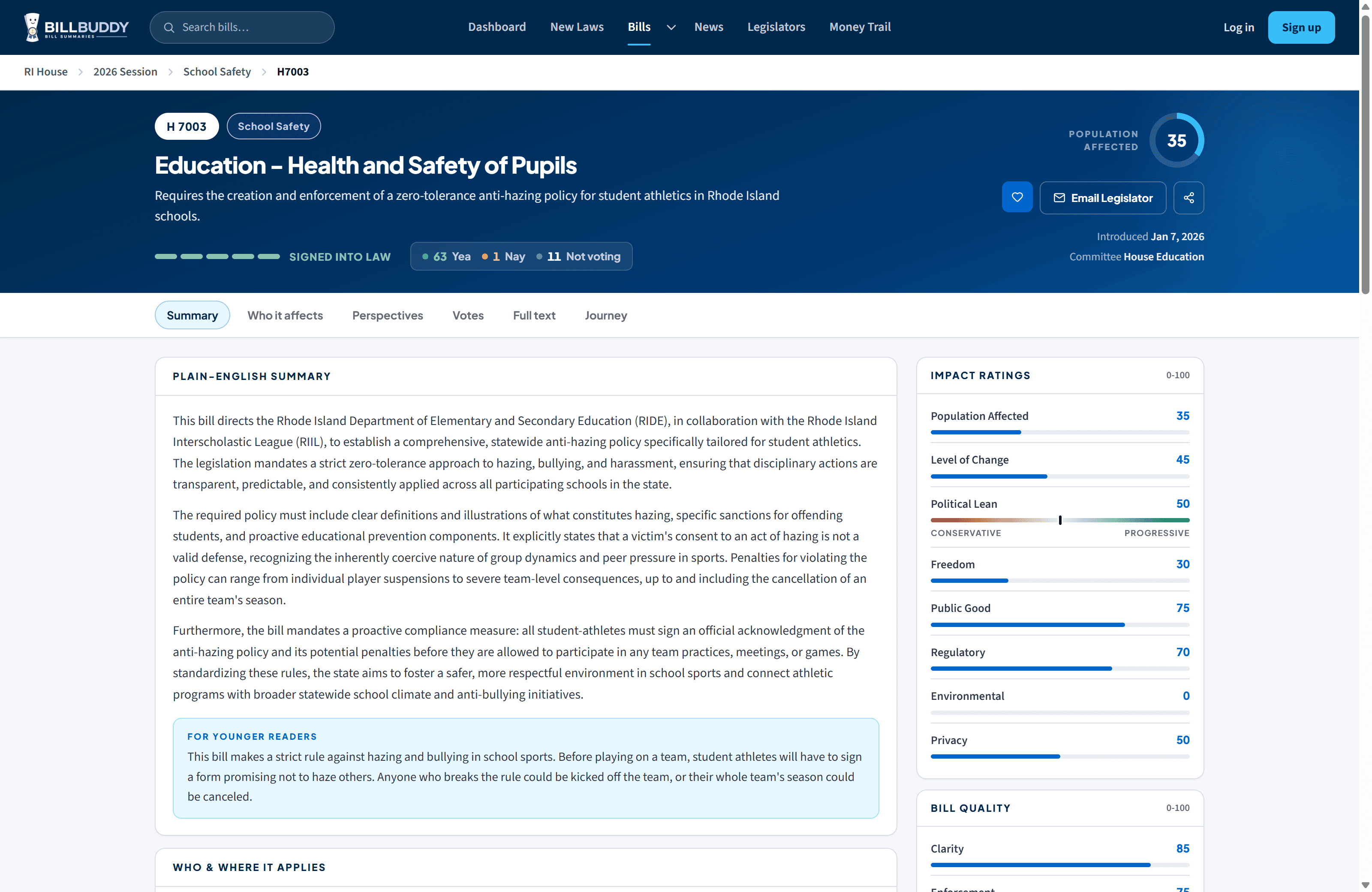
The editor's desk
Every held story lands here with the reason spelled out — weak sourcing, an unverified bill, a failed image check. The editor can approve, schedule, reject, or send it back with notes the AI actually uses in the rewrite.
Each reporter runs in auto or approval mode, and one switch pauses all auto-publishing instantly. The machine earns trust one beat at a time.
The AI drafts, a person decides.Limited sourcing — 4 sources, 1 primary. An editor decides whether this one runs.
Games that bring readers back
A daily Rhode Island connections game, a weekly crossword, and a photo geography game — generated on a schedule, checked before release, complete with streaks and shareable results.
News sites live and die on return visits. The games give readers a reason to come back every day, even on a slow news day.
Yes, the crossword writes itself.
Automation you can put your name on.
The hard part of an AI newsroom isn't the writing — it's making sure the machine can't quietly cut corners. So the rules are enforced by code, not by hoping.
It can't grade its own homework
A story's sourcing score is computed from the documents it actually gathered — and when the AI is more confident than the evidence, the stricter grade wins.
The official record always wins
Any story touching a bill is checked against the legislature's own data before publish. If a source says “passed” and the record says “pending,” the record wins.
Every image is inspected
Generated illustrations follow strict ethics rules — no real people, no restaged events — and each one is machine-inspected before the story can go public.
Humans hold the pen
Most reporters publish nothing without an editor's sign-off. The rest earn autonomy inside tight rules — and one switch pauses everything.
A style guide with teeth
Banned clichés, limits on leaning on other outlets, a hard rule to write shorter rather than pad — enforced in the drafting itself, not cleaned up after.
The playbook is audited
Every AI instruction is versioned, and a one-command audit compares what's running in production against the spec — so the system can't drift quietly.
What a staff of one keeps running.
Rhode Island cities & towns covered
bills tracked & summarized each session
legislators with voting records
AI reporters, each with a beat
automated pipelines behind the scenes
jobs running on a schedule, day & night
tuned AI instructions, all editable
automated tests keeping it honest
It publishes while the editor sleeps.
More from the workbench.


Got more reading, sorting, or writing than your team can hold?
The same recipe — watchers, research, drafts, automatic checks, a human sign-off — works on invoices, inboxes, filings, and reports. Tell us what you can't keep up with, and we'll tell you what a machine could take off your plate.